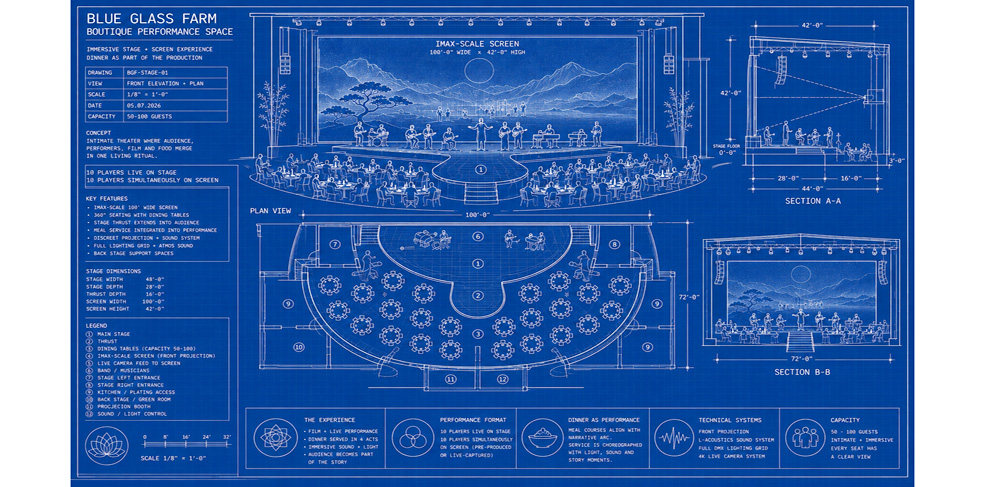
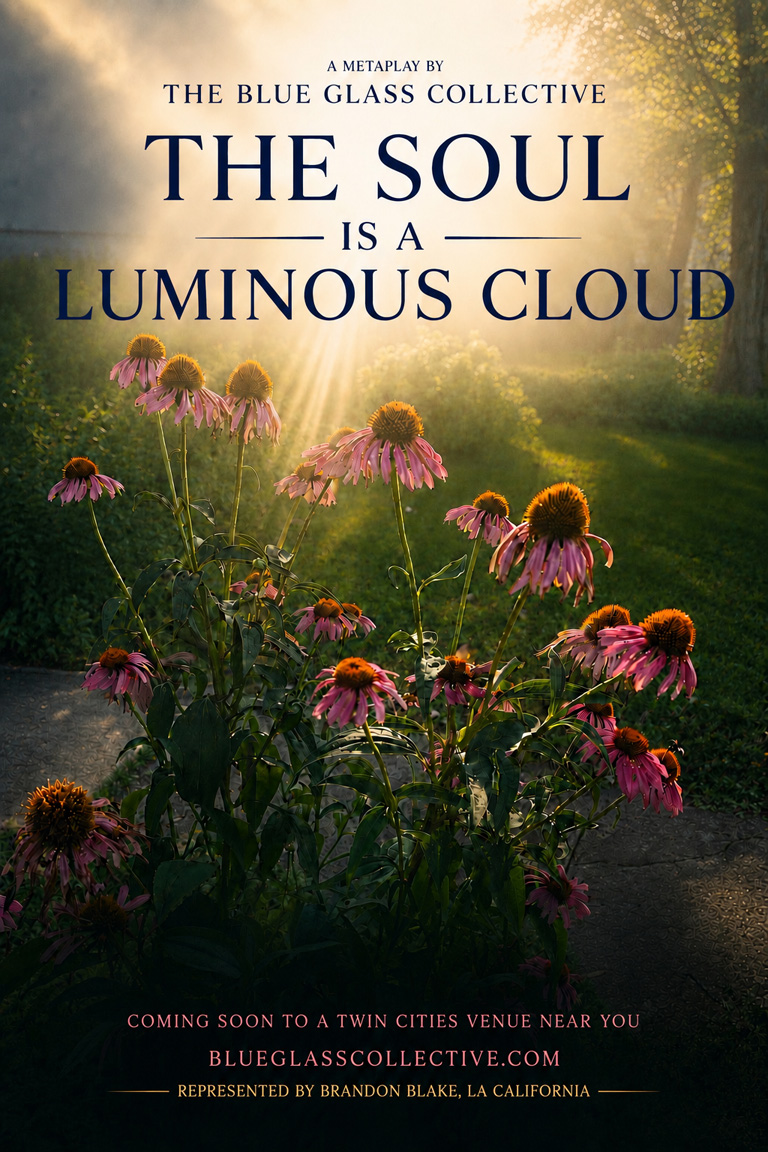
Blue Glass Boutique Performance Space

why blue glass?...

Blue Glass exists because many contemporary cultural structures are optimized for speed, visibility, and extraction rather than depth, trust, or transformation.

It offers an alternative model—one that prioritizes: • Presence over performance • Relationship overreach • Craft over content churn • Long horizons over quick wins

Blue Glass is not designed to scale quickly. It is designed to last, to deepen, and to remain hospitable to the human spirit over time.

rule

emerging awareness

Emerging Awareness

shifts happen

Each person brings their own history, perception, and capacity for attention. But as these begin to align—not through conformity, but through attunement—a shared pattern emerges. This pattern is not imposed from above, nor constructed through agreement. It arises through relationship.


One might think of it less as orbit and more as resonance. Not separate bodies moving around a fixed center, but a system of elements adjusting to one another until a stable pattern forms. In music, this would be harmony. In physics, coherence. In lived experience, it is the moment when separate lives begin to move in the same pattern.
Such moments are often brief. They cannot be held indefinitely. But they leave a trace.


People leave these experiences with a sense that something has shifted—not only within themselves, but between them. That what occurred was not reducible to any single person’s contribution. That something was found that could not have been made alone.

sneaky love


Sneaky Love is the Blue Glass idea that love can enter a person, a room, or a community most powerfully when it arrives without announcing itself as love.

The phrase we arrived at was essentially:

Love enters without announcement, before the ego can defend against it.

Instead of preaching compassion, announcing a spiritual intention, or trying to manufacture intimacy, Sneaky Love works indirectly. It consists of small, unexpected acts of attention, generosity, humor, tenderness, inclusion, beauty, and recognition—things that subtly change the emotional atmosphere without demanding acknowledgment or reciprocity.

That was important because we saw Sneaky Love not merely as “random acts of kindness,” but as a Blue Glass methodology. In a gathering, performance, dinner, neighborhood, or even an entire city, the participants quietly introduce these acts into the social field. Nobody needs to say, "Now we are creating community." The defenses that sometimes arise around earnestness, spirituality, therapy, or organized community-building are bypassed.

The deeper principle was: create the conditions, then get out of the way. Disarm the room. Shift attention. Allow silence. Let people recognize one another. Don’t immediately explain what happened or name the experience. Trust the field and let love move quietly through it.

And at its most ambitious, Sneaky Love becomes almost a form of cultural acupuncture: Blue Glass artists and participants introduce tiny acts of compassion and human recognition into communities, gradually altering the emotional ecology of a place—perhaps so subtly that the community changes without quite knowing why.

That last dimension, is what makes Sneaky Love distinctly Blue Glass rather than simply another kindness project.

(Jeff Hogue gives Annie Ellicott and Eve Berry credit for these ideas.) 

rule

authentic community

transcending the individual

There is a body of understanding that has appeared, in different languages and forms, across cultures and centuries. It is sometimes called perennial wisdom—the recognition that human beings can come into alignment with a deeper reality, and that this alignment is not merely conceptual, but experiential. Whether expressed through Sufi practice, contemplative traditions, or philosophical inquiry, the core insight remains consistent: there is something more fundamental than the individual ego, and it is possible to come into relationship with it.


Much of this wisdom, however, has been oriented toward the individual. The question has traditionally been: how does a person awaken, integrate, or come into alignment with what is real? In psychological language, this becomes the process of individuation. In spiritual language, it is often described as union, surrender, or realization. The path varies, but the structure is similar—an individual moves from fragmentation toward wholeness.


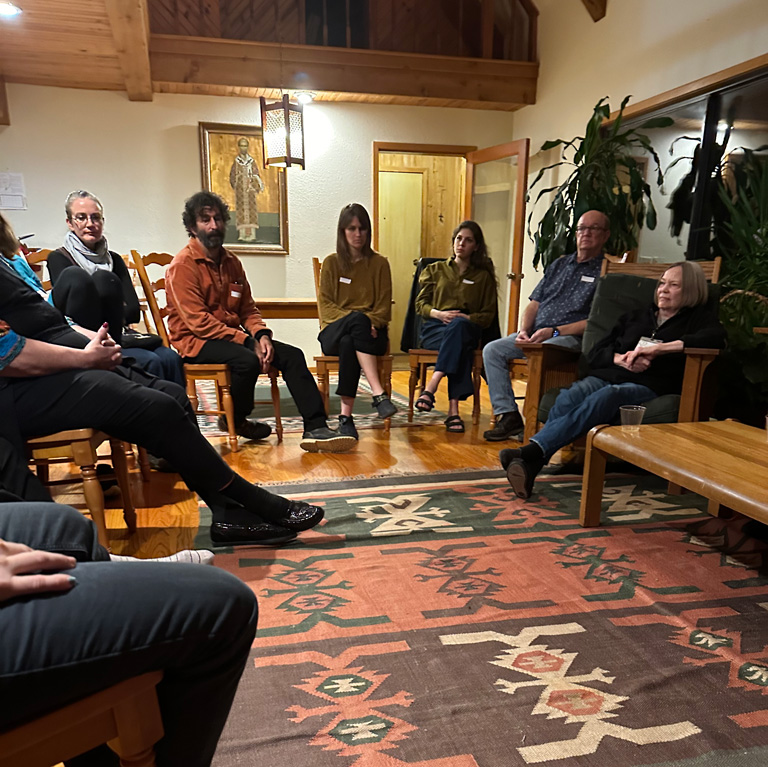
What has been less explored is what happens when this movement is no longer confined to the individual. The work of Blue Glass begins at precisely this point of extension. It asks a different question: what becomes possible when a group of people comes into alignment—not as a collection of individuals having parallel experiences, but as a coherent field?


This is not metaphor. It is something that can be perceived directly when conditions are right. Attention stabilizes. The noise of self-presentation begins to fall away. People become more aware not only of themselves, but of the space between them. At a certain threshold, something shifts. The group is no longer simply a gathering of individuals. It begins to function as a single, responsive system.


This shift is subtle, but unmistakable. It cannot be forced, and it cannot be simulated. It emerges when certain conditions are present, and dissolves when they are not.

Emerging Awareness

"A community is the mental and spiritual condition of knowing that the place is shared, and that the people who share the place define and limit the possibilities of each other's lives. It is the knowledge that people have of each other, their concern for each other, their trust in each other, the freedom with which they come and go among themselves."
– Wendell Berry